

Lead with Precision™
Stop managing the system's
reaction to your standard.
You do not need more development. You need a structural repair. The Precision Repair Kit helps you protect the standard, reduce drag, and lead with clarity without tightening into control.
Get The Repair Kit
The shift you are here for
You already know your pathway.
Now learn how it behaves under pressure.
Precision is not the problem. Your clarity is one of the ways the system finds direction. But when the terrain gets tense, clarity can start tightening into control. The next step is not more self-awareness. The next step is repair.
A standard can become a rule the team follows without understanding what it protects.
A process can become a rut when it serves the habit more than the outcome.
A correction can land as criticism when the system has not made the expectation visible.
A leader can become the structure when the team depends on them to catch every gap.
The repair is not to lower the standard. It is to build a system strong enough to hold it.
Precision leadership does not need to soften. It needs to become transferable.
The Repair Kit helps you separate the standard from the friction, identify where control is tightening, and make one structural adjustment close to the work.

What Precision does under pressure
Your strength is still the signal.
But pressure changes how it lands.
Precision is most useful when it creates structure other people can move inside. Under pressure, that same strength can start doing too much. The goal is not to abandon clarity. The goal is to notice when clarity is becoming the only thing holding the system together.
Names the outcome the team is protecting, not just the task they need to complete.
Turns expectations into visible standards people can use without constant correction.
Clarifies decision points, ownership, follow-up, and what “done” actually means.
Uses feedback to repair the system, not to prove someone should have known better.
Builds standards that travel, so the work can hold when you are not in the room.
Tightens control because the system does not yet feel mature enough to trust.
Corrects downstream instead of repairing the unclear expectation upstream.
Protects the rule longer than it protects the outcome the rule was supposed to serve.
Carries the standard personally until the team depends on one person catching every gap.
Creates compliance without ownership, speed without learning, and activity without cleaner movement.
The repair is not to become less precise. The repair is to separate the standard from the friction, then build a structure strong enough to hold the work without requiring your constant intervention.
Three repair moves
The standard can stay.
The structure needs to change.
Repair Move 01
Separate the standard from the friction.
Not every failure is a standards problem. Sometimes the process is weak, ownership is unclear, or the person lacks capacity, authority, skill, or context. Repair starts by naming the layer that is actually breaking.
Repair Move 02
Audit the rule before you enforce it.
A rule can be clear and still be wrong for the current terrain. Precision repair asks whether the rule still protects the outcome, or whether it is preserving the way the work has always been done.
Repair Move 03
Return ownership without dropping the standard.
When Precision is overextended, the leader becomes the final checkpoint. The repair is to give the work back with the standard attached, so the system becomes stronger instead of more dependent on your intervention.
Precision does not need to lower the bar. It needs to make the bar visible, usable, and transferable.
The work is not to become less exacting. It is to create a structure where clarity, ownership, and follow-through hold without requiring you to personally carry every standard.
The tension this repair holds
The standard matters. But the standard cannot depend on you personally holding it up.
The process matters. But the process has to serve the outcome, not just maintain the habit.
Accountability matters. But accountability works best when ownership, authority, and follow-up are visible before the correction happens.
The Leadership Cartography™ Practice
Three territories.
One map.
Identity
Your pathway has a name.
The Precision pathway names a specific leadership territory: clarity as the offer, structure as care. The assessment tells you this is not rigidity. It is a particular intelligence about how exact language gives people structure they can rely on.
Terrain
The map names what was already true.
Precision terrain produces recognizable patterns. Standards that others experience as pressure. Feedback that feels thorough to you and overwhelming to them. A kind of loneliness that comes from seeing what the system could be. The map names what has been happening.
Navigation
Legibility is what the map gives you.
Knowing the terrain makes it legible. The gap between what you see and what others can see has a name, and what looked like a communication problem starts to look like a translation need instead.
You do not need to choose between moving fast and building something that lasts. The Precision pathway shows you how the two belong in the same system.

Go deeper into
your Precision terrain.
If Lead with Precision™ is your pathway, the full terrain reading gives you the deeper map: how your standards function, where clarity can tighten under pressure, and what conditions help your leadership become more useful, trusted, and transferable.
Get the Full Terrain ReadingNeed help with a specific pressure point? Feedback Pattern · Delegation Block · Managing Up
Explore the terrain
Where this pathway
is most tested.
Feedback Pattern Map
When feedback is frequent but standards remain unclear.
Delegation Block Map
When work is assigned but accountability does not hold.
Time Management Map
When priorities shift faster than execution can stabilize.
Managing Up
When decision authority is unclear or inconsistent.
Team Dynamics Map
When coordination breakdowns compromise results.
You do not need to work on all of these. Noticing which one is active is often enough to change how this week unfolds.
Free Tools
Free Tools for Precision Leaders
Two tools to use right now — no purchase required.
Free Reflection Tool
The Feedback Reality Audit
A free reflection tool to help you assess whether the feedback systems around you are producing accurate signal — or just noise that looks like data.
Get the Free ToolFree Script Tool
Feedback Scripts for Precision Leaders
A free script tool to help you deliver feedback that is direct, grounded, and specific — without losing the relationship in the process.
Get the Free Scripts
Not sure this is your pathway? Start with the assessment.
This page assumes Precision is already your result. If you are not sure, take the Source Assessment first. It will show you the leadership pathway you default to under pressure, so you are not trying to repair the wrong terrain.
Ten minutes. Free. Your result arrives by email.
START WITH DISCOVERY
If you are newer to managing people,
start here first.
The Discovery Toolkit is for managers who know Precision is their pathway, but are still learning how that pattern shows up in real leadership moments. Start here if you are newly promoted, newly responsible for a team, or still building language for the way you lead.
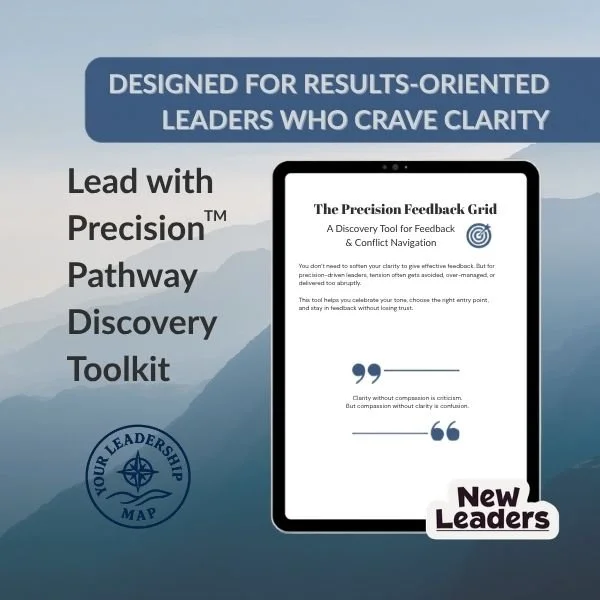
Lead with Precision™ helps results-oriented managers set clear standards, streamline systems, and measure progress without micromanaging.
What you’ll get:
A guided discovery sequence to clarify your natural precision style
Fillable tools for setting goals, feedback grids, and progress maps
Reflection prompts for balancing clarity with flexibility
A one-page standard map to anchor expectations
Format: Fillable PDF (instant download)
Ideal for: Results-driven managers, team leads, and new supervisors who want to sharpen performance without sacrificing trust
Common questions